What's Inside Korea?
Discovering the past and Present of Korea
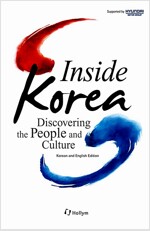
Korea is a nation with about five thousand years of history and rich cultural heritage and a country realized stunning economic growth and democratic development in such a short span of time. In addition, Korea has recently been put on the proverbial global map propelled by the Korean wave which hit the world, but the country is still far from well-known across the world. What is Korea like? In fact, it is not easy for both Koreans and non-Koreans to answer to this question. It is where the idea of this book first created.
This book is designed to increase understanding about Korea for people around the world and to present Korean society and culture in refined manner to foreigners who are not familiar with. Most of the information in the book can be easily accessed through the Internet, but books are still the best method to systemize information on such a broad subject and to make it understandable to a wider range of people regardless of time or place. That being said, this book has a great deal to offer people around the world.
This book mainly consists of three parts. The first part (pp. 1-32) offers a brief introduction to Korea with reliable barometers in many aspects of Korean identity. The main part (PP. 33-446) of this book reveals Korea by eight categories: geography, history, politics, economy, society, culture, religion and religious culture, and scientific technology and industry. Two special commentaries on the North-South relations and East-West cultural differences are to help readers better understand Korea as a "divided country" with "Confucian culture." Finally the last appendix part contains a lot of statistic information that readers can refer to.
" 내용 소개 | Contents
Preface | Notes | Korea at a Glance
01 지리 Geography
This chapter looks at Korea's location, climate, topography, plants and animals administrative districts, population, and cities, which greatly affected the country and Koreans' life for so long.
02 역사 History
This chapter briefly describes the history of Korea from the early Paleolithic Age to the establishment of current government.
Introduction | 1. The Dawn of Korean History | 2. The Three Kingdoms, Unified Silla, and Balhae
3. Goryeo: Land of Empire | 4. Joseon, the Confucian State | 5. Modernization: Exertion & Frustration
6. Japanese Colonial Rule & the Independence Movement | 7. Establishment & Development of the Republic
of Korea
03 정치 Politics
This chapter introduces Korea's political system and diplomatic relations with neighboring countries.
1. Constitution | 2. The Presidential System | 3. National Assembly | 4. Diplomacy
5. Symbols of Korea (Republic of Korea, Aegukga, Taegeukgi, Mugunghwa)
[Special Feature] Understanding of North-South Relations
This chapter examines the background behind the national division, the Korean War, and North-South relations after the war to help international community gain a greater understanding of the two Koreas.
04 경제 Economy
In this chapter, the history of Korea's economic growth and the strategies that make it happen are briefly reviewed. In addition, the causes of the current economic problems are examined in detail.
Introduction | 1. Economic Strategies and Achievements after the War
2. Heavy Industry Strategy, the Depression of 1980 and Beyond
3. Economic Democracy and Banking Liberalization after 1986
4. The Financial Crisis of 1997 and Solution | 5. The Korean Economy after the Asian Financial Crisis
05 사회 Society
In this chapter, the dynamic transformation of Korean society and its people are examined.
Introduction | 1. Compressed Modernization: The Key to Understanding Modern Korean Society
2. Population, Households, and Dwellings | 3. Family, Marriage, and Women
4. International Marriages and a Multicultural Society | 5. Education
6. Employment and Welfare | 7. Religion and Leisure Time
06 문화 Culture
This chapter reviews some cultural elements which are a part of the everyday life of Koreans, such as clothing, food, housing, and popular culture.
Introduction | 1. Korean and the Korean Alphabet | 2. Rites of Passage | 3. Clothes
4. Dwellings | 5. Food | 6. Fine Arts and Pop Culture | Conclusion
[Special Feature] Comparison of Eastern and Western Culture
This chapter focuses on a comparison between Korean and US culture to help people from other countries gain a better understanding of Korea and its culture.
07 종교와 전통문화 Religion and Religious Culture
This chapter describes various features associated with religions in Korea as well as cultural traditions that have been influenced by religions.
08 과학기술과 산업 Scientific Technology and Industry
This chapter looks at the background of Korea's stunning economic growth and the process of industrial development after 1960.
Introduction | 1. Construction Industry | 2. Steel Industry | 3. Shipbuilding Industry | 4. Automotive Industry
5. IT Industry | 6. Development and Dissemination of Science and Technology | Conclusion
참고문헌 Bibliography
부록 Appendix
" 저자 소개 | Authors
Geography Kim Jong-hyuk Research Institute of Korean Studies, Korea University
History Yum Bok-gyu National Institute of Korean History
Politics Choi Il-sung International Relations, Hanseo University
Economy Park Yong-jin Economics, Connecticut College
Society Yang Han-soon Sociology, Ajou University
Culture Lee Eung-chel Cultural Anthropology, Duksung Women's University
Religion and Religious Culture Choi Jun-shik Korea Culture Research Institute,
Ewha Womans University
Scientific Technology and Industry Kim Shi-dug The National Museum of Contemporary
Korean History
Understanding of North-South Relations Kim Il-pyong Professor of Politics, Emeritus,
The University of Connecticut
Comparison of Eastern and Western Culture Kim Ki-hoon Professor of Economics, Emeritus,
Central Connecticut State University
서울시립대학교 국사학과 교수
서울대학교 국사학과를 졸업하고, 동 대학원에서 한국근현대사 전공으로 박사학위를 받았다.
주요 저서로 『서울의 기원 경성의 탄생』(이데아, 2016), 『도시를 보호하라』(역사비평사, 2021, 공저), 『동아시아 재난의 근현대사』(역락, 2022, 공저), 『서울은 기억이다』(서해문집, 2023, 공저) 등이 있다.




 (0)
(0)



 최근작 :
최근작 :